



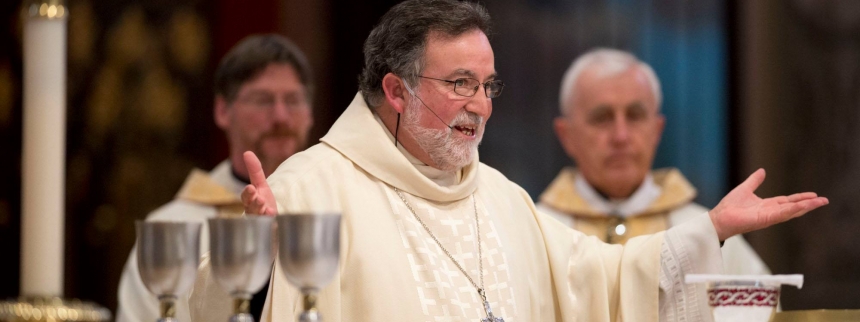
Whenever I’ve been scheduled to speak with parents about how to discuss sexuality with their children, the room is usually packed with concerned mothers and fathers.They’re either very interested in the topic or curious to hear a bishop speak on it. Several times during my ministry, I have also been called upon to speak to young people about Catholic teaching on sexuality.
At one speaking engagement involving high school students, parents were invited to sit in the back of the room. I had learned to keep my prepared remarks brief and leave plenty of time for questions. Usually, when I opened the floor for questions, there was an awkward silence, then a few softball questions, before someone would ask what was really on their minds.The parents’ presence in the room may have given the young people more reason to pause.
From that session I don’t recall the number or types of questions, except one. The youthful inquiry could have been taken from an old moral manual used at seminaries. A young man asked, “How long can I kiss my girlfriend before it is a sin?” I stepped back to ponder a response then proposed, “Imagine your parents are in the room as you kiss one another. Whatever that length of time may be the morally permissible limit.” From the back of the room, there was some elbowing and nodding in agreement.
During a conference given to young adults, a young woman asked me, “How long should I wait for my boyfriend to propose marriage?” I suggested that five years might be a reasonable limit. A couple of other priests in the room offered different judgments on the prudent timetable for courtship.
These impromptu questions touch on distinct aspects of a relationship between a man and woman, the former seemingly superficial, the latter intent on a commitment. Both were grasping for certainty in a realm filled with ambiguity. My responses may have offered some clarity, but every relationship is as unique as the individuals involved.
Research is emerging that highlights the questions and struggles many young people experience in forming long, lasting relationships. This is not limited to romantic relationships or courtships. Young men and women are also struggling to form friendships among their peers. The social skills and habits for forming good relationships are learned over time, and with much practice. Experiences of success and failure help us learn about ourselves and engage one another with a modicum of confidence, mutual respect and resilience if a friendship sours.
We are made for relationships; made to form good friendships. In a healthy climate of relationships, the close, romantic bonds between a man and woman that lead to courtship and marriage become possible for young people. Having friends, and being a friend to others, is an essential social and personal building block. Without the experiences and habits that come from being a friend and having friends, the capacity to form the lifelong relationships required for marriage remains out of reach in the minds of many young people.
The same can also be said for those aspiring to the priesthood or religious life. If someone has not acquired the capacity to form healthy friendships, celibacy will seem out of reach or appear isolating and unattractive.
It may be easy to point a finger at hand-held mobile devices but, sadly, there are other ill-suited teachers. Though technology has unquestionably improved the quality of life for those who have access to it, when used frequently it becomes an addictive proxy that offers predictability for aspects of life that inherently come with some unpredictability. In a world with little moral compass, most moral decisions tend to be transactional — even relationships. Quid pro quo becomes the moral measure.
While these and other predominant cultural features are all at the fingertips of young people, the habits and resilience of good human friendships seem out of their reach, unattainable if not undesirable. Many of these bad habits are simply filling a vacuum left by a lack of customs and habits for forming good friendships.
One of the vacuums created is the infrequency, if not total absence, of regular family communal meals. How often do we sit down for a meal with our families? The art of good conversation, respectful listening and enjoying another’s company are learned over a shared meal.
The dearth of habitual common courtesies also leaves a social vacuum. The failure to teach simple habits of human courtesy turns every human encounter into a personal threat to be feared. With eyes locked onto our cell phone screens, any human interaction is presumed to be a distraction or a disruption. The more common attempt at courtesy is often a quick “sorry,” “oops” or silence.
The gospel according to St. John intertwines the two human aspirations, friendship and marriage, as principal revelations about the Lord Jesus. As He prepared to die, He told his disciples, “You are my friends.” In describing a good friend, Jesus was referring to himself. “No one has greater love than this, to lay down one’s life for one’s friends.” (Jn 15:13)
This same gospel that spoke so eloquently about friendship, also revealed Jesus as the bridegroom. John the Baptist presented himself as the “friend of the bridegroom” (Jn 3:29-30). Mary, who listened to her son speak of the awaited hour while at the wedding feast at Cana, stood at the foot of the cross when that hour came, the hour of the wedding feast of the Lamb of God (Jn 2:4).
These beautiful images of Jesus as the good friend and sacrificial bridegroom speak to the relational nature of humanity by which Jesus chose to reveal his divine love for us. That both are part of John’s gospel narrative reflects their complementary roles in helping the human person encounter the Lord Jesus. This makes it even more necessary for us to learn and teach others how to respect, accompany and love one another.
When we revive for our young brothers and sisters the goodness of healthy friendships, a renewed appreciation for the beauty of the wedding covenant follows. Then, our human nature can more fully participate in the divinity of Christ, our good friend who is also the merciful spouse of his bride, the Church.